Sum muzik for friday morn…
Posted in Uncategorized
A few more days…
And I get to head west. I get to go out in small boats in the big ocean and have fun. I get to wear my arm out casting that dern fly on the end of that dern little line. I get to spend a couple nights under a sago leaf roof in a mosquito net. I’ll be getting up way early and be walking the flats well before sunrise. I’ll be feeling like a predator, a hunter, a man with a mission. And I’ll get to kill something big, I hope. A nice mamulla or even a king fish… on a fly line.
Can’t wait!
But for now… Stuck in Honiara. Grace is in Gizo. Will have the grandkids this weekend so it will be a bbq and pool this eve then a mass pass-out in front of the TV and a blisteringly early morning tomorrow…
Life is guuud…
Posted in Uncategorized
’bout bloody time…
Former Israeli president Katsav jailed for rape
TEL AVIV: Former President Moshe Katsav was sentenced on Tuesday to seven years in jail for rape, a case that brought shame to Israel’s highest office and sent a firm message to a transfixed public that no one was above the law. Katsav had denied charges he twice raped an aide when he was a cabinet minister in the late 1990s, and molested or sexually harassed two other women who worked for him during his 2000-2007 term as president. But a three-judge panel said on convicting him in December on what Prime Minister Benjamin Netanyahu described as “a sad day for Israel and its residents”—that his testimony had been “riddled with lies.” “When a woman says no, she means no,” the panel said in its ruling. Katsav, 65, was also convicted of obstructing justice, for trying to confer with one complainant about her testimony to police. Netanyahu said at the time the verdict showed that “all are equal before the law”. Rape carries a minimum prison term of four years and a maximum of 16 years in Israel. Though the scandal had forced Katsav’s early retirement in disgrace, it had little impact on Israeli government functions, as the presidency is largely ceremonial. reuters
Posted in Uncategorized
The full discussion paper (number 17)
Posted in Uncategorized
Worth a read
YOUTHQUAKE: will Melanesian democracy be sunk by demography?
In its latest briefing paper, the Pacific Institute of Public Policy (PiPP) looks at the need for political reform to governing systems across Melanesia as its young population booms.
It asks a troubling question – will democracy be sunk by demography?
The Pacific in general, but Melanesia in particular faces a serious demographic challenge. More than half the population is under 24 and in broad terms, urban populations are doubling every 17 years while national populations are doubling every 30 years.
The combination of pressures on land, jobs, geopolitics and a failing Westminster system of government is creating anger and frustration with consequences for continuing democratic rule in the region.
As the Great Arab Revolt unfolds on the other side of the world, with young people at the heart of calls for democracy, Melanesia seems to be moving in the opposite direction – from democracy towards autocracy. Right now, the trend in Melanesia is moving more towards Frank’s Fiji than Julia’s Australia.
There is real danger that left unchecked, the rising tide of youth and other frustrated citizens will want autocracy rather than democracy if service delivery continues to fail and there are no options for regional labour migration.
PiPP suggests a need for new thinking is revitalising democracy and governing systems in the region and an urgent need to manage generational change.
The full discussion paper (number 17) is attached.
Posted in Uncategorized
’bout bloody time
 Libya: Colonel Gaddafi in hiding as escape options begin to disappear
by Martin Fricker, Daily Mirror 22/03/2011

COLONEL Gaddafi was last night thought to be hiding in a secret underground bunker – guarded by a 40-strong squad of gun-toting female virgin bodyguards.
The tyrant has not been seen in public since the first allied blitz on Saturday and UK Special Forces sources believe he has fled to Sabha, a desert city of 130,000 people all fiercely loyal to their leader.
As well as his famous female minders – who wear make-up and high-heels – Gaddafi is understood to have surrounded himself with blood-thirsty mercenaries from Chad, Niger and Eastern Europe to give him round-the-clock protection.
But Western governments believe he will quit the country once it becomes clear his days are numbered.
If he does publicly flee or is killed, it is hoped residents in Tripoli and other western Libyan cities will be free to rise up against his brutal regime.
Locals are currently too terrified to show their true feelings, fearing the despot may one day return.
DEATH
Publicly Gaddafi says he will fight to the death, but diplomats say this is extremely unlikely.
Instead it is thought he will go to a “friendly” country such as Zimbabwe, where Robert Mugabe has said he will be welcome. Other possible destinations include Hugo Chavez’s Venezuela and African nations Chad and Niger.
It was for this reason that Western jets bombed an airfield close to the Libyan border in the opening salvo. It was used by private jets belonging to the Gaddafi family and would have been ideal for him to make his escape. Instead it is now partially destroyed thanks to laser-guided bombs from French and British jets.
Gaddafi went to ground shortly before air strikes were carried out on key targets and resorted to speaking on state TV by telephone over the weekend rather than appearing on camera.
Experts said he probably took the decision in case his appearance gave a clue to his exact whereabouts. He is thought to have fled Tripoli to escape the aerial bombardment from allied fighter jets. But a number of Gaddafi’s sons have remained to help with logistics. They included Khamis, 32, who reportedly died from severe burns after his father’s main Bab al-Azizia base was pounded. His older brother Saif al-Islam, 38, is still believed to be in the capital.
He claims to be head of the “modernising wing” of the family and regularly appears on TV.
Saif has travelled widely and wrote his PhD thesis at the London School of Economics on the role of civil society in democratisation.
Saadi Gaddafi, 37, is a former professional footballer in Malta and Italy, but is now head of the Libyan special forces. Mutassim Gaddafi, 33, is possibly the most powerful of the four siblings, holding the position of National Security Adviser.
Posted in Uncategorized
Mike the voyeur…
Had some fun being a voyeur from my verandah yesterday…
The neighbors were cutting the top off a big coconut tree which was fun to click snaps of…
before:
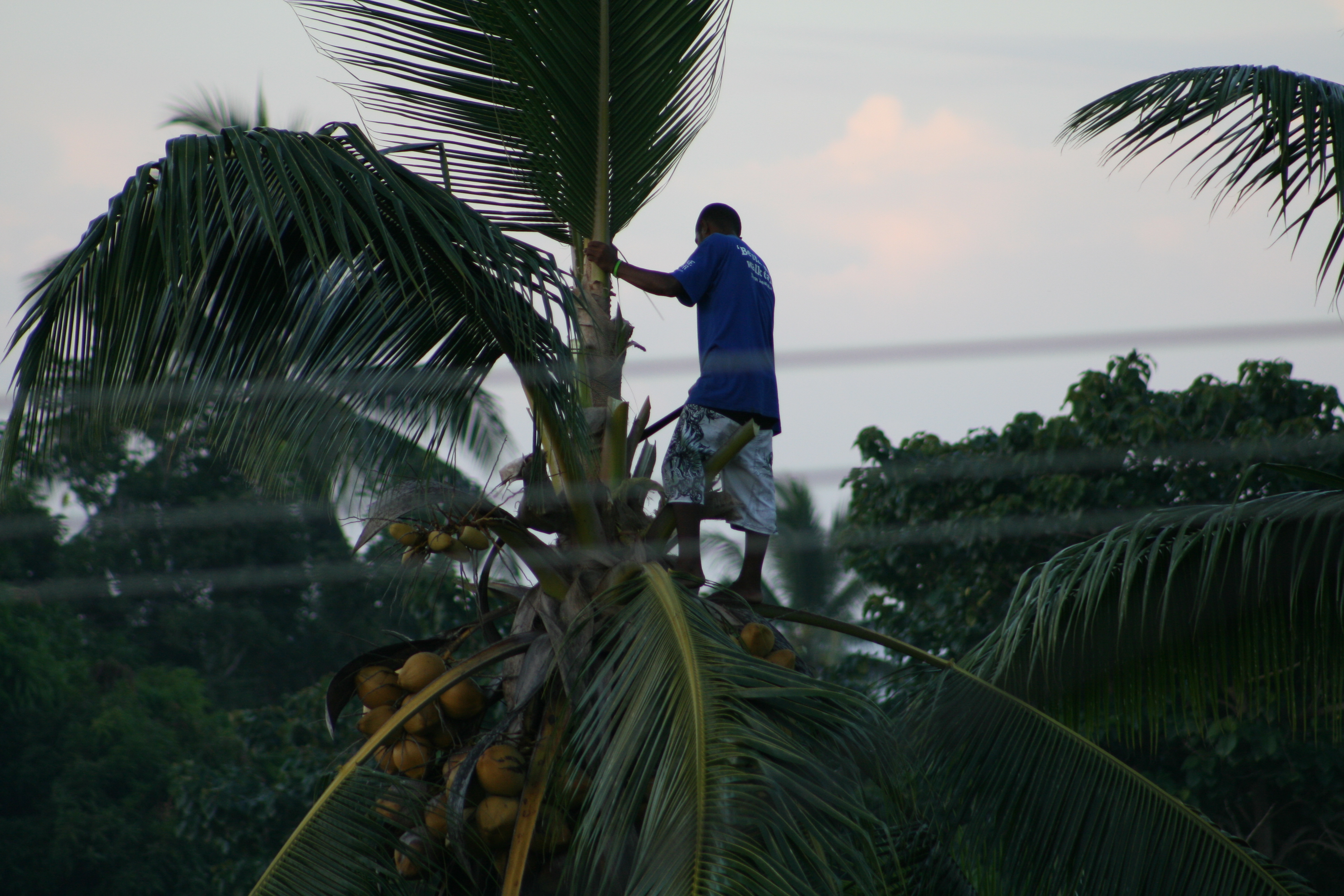
after:

Posted in Uncategorized
No gud newz…
Attack comes despite unilateral ceasefire declared by Libyan government; France’s UN envoy predicts imminent military action following UN authorization for no-fly zone.
Libyan leader Muammar Gadhafi’s forces attacked early on Saturday the eastern city of Benghazi, defying world demands for an immediate ceasefire and after France’s United Nations envoy predicted an imminent military action.
Explosions shook Benghazi while a fighter jet was heard flying overhead, and residents said the eastern rebel stronghold was under attack from Gadhafi’s forces.
“The explosions started about 2 a.m. Gadhafi’s forces are advancing, we hear they’re 20 kms from Benghazi,” Faraj Ali, a resident, said.
“It’s land-based fire. We saw one aircraft,” he added.
Libya had declared a unilateral ceasefire on Friday after the United Nations Security Council authorized a no-fly zone over Libya, but the United States said the ceasefire was not being respected.
Libyan rebels said on Saturday they were being forced to retreat by Gadhafi’s forces.
“They were 60 km away yesterday, today they are 20 kms away and they can be here in a half hour to 90 minutes,” rebel fighter Khalid Ahmed told Reuters at a rebel base on the western edge of the city.
Elsewhere in the city, rebels also reported skirmishes and strikes by Gadhafi forces.
“Fighter jets bombed the road to the airport and there’s been an air strike on the Abu Hadi district on the outskirts,” Mohammed Dwo, a hospital worker and a rebel supporter, told Reuters.
He was speaking at the scene of an apparent firefight between rebels and what they claimed were two mercenaries who had infiltrated the city and were driving in a car which they said contained a crate of hand grenades.
The two men, in civilian clothes, had been shot and killed and rebels produced blood-soaked identity papers they said showed them to be of Nigerian nationality.
“We were sitting here and we received gunfire from this vehicle then we opened fire and after that it crashed,” rebel fighter Meri Dersi said.
Jamal bin Nour, a member of a neighborhood watch group, told Reuters he had received a call to say government forces were landing by boat, but it was impossible to confirm the information.
The city has been so rife with rumors and hearsay that it is virtually impossible to verify due to lack of communications.
A unilateral ceasefire declared on Friday by the Libyan government appeared to have done little to convince outside powers to hold off on plans for air strikes to force an end to an increasingly bloody civil war.
Residents in the rebel-held western city of Misrata said they faced heavy bombardment on Friday — a charge the government denied — while a U.S. official said Gadhafi’s forces were still advancing towards the rebels’ eastern stronghold Benghazi.
Within hours of President Barack Obama saying the terms of a UN resolution meant to end fighting in Libya were non-negotiable, his UN envoy, Susan Rice, asked by CNN whether Gadhafi was in violation of these terms, said: “Yes, he is.”
Gadhafi said there was no justification for the UN resolution.
“This is blatant colonialism. It does not have any justification. This will have serious consequences on the Mediterranean and on Europe,” he said in comments reported by Al Jazeera television.
France, which along with Britain has been leading a drive for military intervention, will host a meeting on Saturday on Libya which will be attended by U.S. Secretary of State Hillary Clinton and Arab leaders.
“So I guess that after this summit, I think that in the coming hours, I think we will go to launch the military intervention,” the French ambassador to the United Nations ambassador Gerard Araud told BBC’s Newsnight.
Obama made clear any military action would aim to change conditions across Libya — rather than just in the rebel-held east — by calling on Gadhafi’s forces to pull back from the western cities of Zawiyah and Misrata as well as from the east.
“All attacks against civilians must stop,” Obama said, a day after the UN Security Council passed a resolution authorizing international military intervention.
A U.S. national security official, who spoke on condition of anonymity, later said the troop movements by Gadhafi’s forces towards Benghazi were “purposeful”. The assessment was based on official reporting reaching U.S. national security agencies.
It was impossible to contact anyone on the frontline far to the west of Benghazi to find out what was happening. But in Benghazi, rebels dismissed the ceasefire declaration as a ruse.
“He is lying. His troops are advancing. We don’t believe what Gadhafi says,” said Mohammed Ishmael al-Tajouri, from the rebel coalition in Benghazi. “When he comes to Benghazi he will be fighting. There is no negotiating with Gadhafi.”
In Tripoli the government said there had been no bombing since it announced the ceasefire.
“We have had no bombardment of any kind since the ceasefire was declared,” Deputy Foreign Minister Khaled Kaim told journalists when asked about reports of continued government operations in Misrata and other parts of the country.
Kaim said Libya was asking China, Germany, Malta and Turkey to send observers to monitor its adherence to the ceasefire.
Posted in Uncategorized
African Union Communique
OF THE PEACE AND SECURITY COUNCIL
The Peace and Security Council of the African Union (AU), at its 265th meeting held at the level of Heads of State and Government, on 10 March 2011, adopted the following decision on the situation in Libya:
Council:
1. Takes note of the statements made by the Chairperson of the Commission, as well as by the representative of the Great Socialist People’s Libyan Arab Jamahiriya;
2. Recalls communiqué PSC/PR/COMM(CCLXI) adopted at its 261st meeting, held on 23 February 2011, and the statement issued, the same day, by the Chairperson of the Commission;
3. Expresses AU’s deep concern at the prevailing situation in Libya, which poses a serious threat to peace and security in that country and in the region as a whole, as well as to the safety and dignity of Libyans and of the migrant workers, notably the African ones, living in Libya. Council is equally deeply concerned with the resulting humanitarian situation;
4. Expresses AU’s solidarity with Libya, and underscores the legitimacy of the aspirations of the Libyan people for democracy, political reform, justice, peace and security, as well as for socio‐economic development, and the need to ensure that these aspirations are fulfilled in a peaceful and democratic manner; in this context, Council takes note of the stated commitment of the Libyan authorities to embark upon the path of reforms;
5. Reiterates AU’s strong and unequivocal condemnation of the indiscriminate use of force and lethal weapons, whoever it comes from, resulting in the loss of life, both civilian and military, and the transformation of pacific demonstrations into an armed rebellion; Council deeply deplores the loss of human life, conveys its condolences to the families of the victims and wishes early recovery to those who have been injured;
6. Reaffirms its strong commitment to the respect of the unity and territorial integrity of Libya, as well as its rejection of any foreign military intervention, whatever its form;
7. Expresses its conviction that the current situation in Libya calls for an urgent African action for: (i) the immediate cessation of all hostilities, (ii) the cooperation of the competent Libyan authorities to facilitate the timely delivery of humanitarian assistance to the needy populations, (iii) the protection of foreign nationals, including the African migrants living in Libya, and (iv) the adoption and implementation of the political reforms necessary for the elimination of the causes of the current crisis;
8. Decides to establish an AU ad‐hoc High‐Level Committee on Libya comprising five Heads of State and Government, as well as the Chairperson of the Commission; Council requests the Chairperson of the Commission to finalize the consultations undertaken in this respect and to announce the composition of the Committee as soon as possible. Council further decides that the Committee is mandated to:
(i) engage with all parties in Libya and continuously assess the evolution of the situation on the ground,
(ii) facilitate an inclusive dialogue among the Libyan parties on the appropriate reforms,
(iii) engage AU’s partners, in particular the League of Arab States, the Organization of the Islamic Conference, the European Union and the United Nations, to facilitate coordination of efforts and seek their support for the early resolution of the crisis ;
9. Further decides that the AU ad‐hoc High‐Level Committee on Libya be supported by a team comprising the Ministers of Foreign Affairs/External Relations and/or other relevant Ministers of the countries concerned, as well as the AU Commissioner for Peace and Security;
10. Requests all AU Member States to provide logistical and humanitarian support to all African migrant workers wishing to leave Libya, as well as to those neighboring countries forced to bear a disproportionate burden and to the countries of origin to facilitate the socio‐economic reinsertion of these migrant workers. In this respect, Council requests the Chairperson of the Commission to take the necessary steps to coordinate such an effort, including the convening of a conference to facilitate the mobilization of the required resources and other related measures;
11. Recalls the provisions of the OAU Convention on the Elimination of Mercenarism in Africa; Council requests the Commission to gather information on the reported presence of mercenaries in Libya and their actions, to enable it, should these reports be confirmed, to take the required measures in line with the Convention;
12. Requests the Chairperson of the Commission to transmit this decision to the United Nations Security Council, the League of Arab States, the Organization of the Islamic Conference, the European Union and other concerned AU partners, for their action as appropriate;
13. Decides to remain actively seized of the matter.
Posted in Uncategorized
’bout bloody time…
LIBYA is ready for a ceasefire with the rebels battling Muammar Gaddafi, but wants to discuss how it will be implemented, deputy foreign minister Khaled Kaaim says.
“We are ready for this decision (a ceasefire) but we require an interlocutor to discuss how to implement it,” Mr Kaaim told a news conference shortly after the UN Security Council voted to permit “all necessary measures” to impose a no-fly zone, protect civilian areas and impose a ceasefire.
“We discussed last night with the UN envoy (for Libya, Jordan’s Abdul Ilah Khatib) and asked legitimate questions on the application of a ceasefire,” he said.
Mr Kaaim indicated that Libya would “react positively to the UN resolution, and we will prove this willingness while guaranteeing protection to civilians.”
The Security Council authorised air strikes to halt Mr Gaddafi’s offensive against embattled rebel forces in the North African country, with the first bombing raids possible within hours.
American broadcaster CNN also reports Mr Gaddafi has changed tact with “a humanitarian gesture”, deciding to hold off on plans to send the army in to Benghazi and mercilessly crush all resistance, as had been promised.
“I just took a phone call from one of Gaddafi’s sons, Seif (al-Islam). This is the message from the leadership,” the CNN correspondent in Tripoli said.
“He said they’re going to change the tactics around Benghazi, that the army is not going to go into Benghazi.
“It’s going to take up positions around the stronghold.
“The reason is they expect a humanitarian exodus.”
Posted in Uncategorized
stay informed…
-
Rebels Claim Small Gains Against Qaddafi Forces (March 17, 2011)
-
Diplomatic Memo: Clinton, in Cairo’s Tahrir Square, Embraces a Revolt She Once Discouraged(March 17, 2011)
-
Times Topics: Libya — The Protests (2011) | Muammar el-Qaddafi
Posted in Uncategorized
Why does everyone wait?
WASHINGTON — The prospect of a deadly siege of the rebel stronghold in Benghazi, Libya, has produced a striking shift in tone from the Obama administration, which is now pushing for the United Nations to authorize aerial bombing of Libyan tanks and heavy artillery to try to halt the advance of forces loyal to Col. Muammar el-Qaddafi.


What Can Arab Leaders Do About Libya?
They may want to oust Muammar el-Qaddafi, but do they really want American or NATO military intervention?
The administration, which remains deeply reluctant to be drawn into an armed conflict in yet another Muslim country, is nevertheless backing a resolution in the Security Council that would give countries a broad range of options for aiding the Libyan rebels, including military steps that go well beyond a no-flight zone.
Administration officials — who have been debating a no-flight zone for weeks — concluded that such a step now would be “too little, too late” for rebels who have been pushed back to Benghazi. That suggests more aggressive measures, which some military analysts have called a no-drive zone, to prevent Colonel Qaddafi from moving tanks and artillery into Benghazi.
The United States is insisting that any military action would have to be carried out by an international coalition, including Libya’s Arab neighbors.
The rapid advance of forces loyal to Colonel Qaddafi, combined with rising calls from the Arab world to prevent a rout of the opposition, has changed the calculations of the administration, which had clung to a belief that interfering in a Middle East uprising could provoke an anti-American backlash.
“The turning point was really the Arab League statement on Saturday,” Secretary of State Hillary Rodham Clintonsaid Wednesday to reporters traveling with her in Cairo. “That was an extraordinary statement in which the Arab League asked for Security Council action against one of its own members.”
Mrs. Clinton said she was hopeful that the Security Council would vote no later than Thursday. The American ambassador to the United Nations, Susan E. Rice, is in intensive negotiations over the language of a resolution, sponsored by Lebanon, another Arab state, and backed by France and Britain.
It is unclear how much the administration is willing to put on the line in Libya, given its deep aversion to being entangled in another war and its clear calculation that Libya does not constitute as vital a security interest to the United States as other countries in the region, notably Egypt or Saudi Arabia. Some administration officials voiced the hope that the mere threat of military action could prompt Colonel Qaddafi to show some restraint.
Still, interviews with several administration officials suggested that events on the ground were forcing its hand. “The regime’s military gains have gotten everyone’s attention,” said a senior official, speaking on condition of anonymity.
President Obama is under pressure from both foreign leaders and allies in Congress to take decisive action. The French president, Nicolas Sarkozy, sent a letter to the United States and other members of the Security Council, urging them to vote for the Lebanese resolution authorizing a no-flight zone, saying that the world had only days, or even hours, to head off a Qaddafi victory.
On Wednesday, one of Colonel Qaddafi’s sons, Seif al-Islam, urged the rebels to leave the country, saying, “Within 48 hours everything will be finished. Our forces are almost in Benghazi.”
Senator John Kerry, the Massachusetts Democrat who is chairman of the Senate Foreign Relations Committee, said he regretted that the debate in Washington over how to respond to Libya had dragged on so long, allowing Colonel Qaddafi to regain his footing.
“I don’t like that we’ve lost this time,” Mr. Kerry said during a speech in Washington. “It’s compacted the choices, diminished the options. And it’s changed the state of play somewhat.”
Administration officials contend that a no-flight zone alone would not be effective, in part because they say it could not be set up before April.
Among the other measures being proposed by the United States: sending foreign soldiers to Libya to advise the rebels, or financing them with some of the $32 billion belonging to the Qaddafi regime, which have been frozen by the Treasury Department. Rebels could use the money to buy weapons, officials said.
Neither of these steps, however, would come in time to stave off an assault by Colonel Qaddafi’s forces on Benghazi.
“What everybody is focused on is drawing a line, literally in the sand, around Benghazi, to prevent Qaddafi’s forces from capturing the city and staging a bloodbath,” said Tom Malinowski, the Washington director of Human Rights Watch. “If Qaddafi wins, it could kill the moment in the entire Middle East.”
But more aggressive military options might make it difficult for a resolution to satisfy Russia and China, two veto-wielding members of the Security Council, which have both opposed such measures in the past. Germany, India and other council members have also expressed skepticism about a no-flight zone.
On Wednesday, Russia pressed for a resolution calling for a cease-fire, but was rebuffed, said Vitaly Churkin, the Russian ambassador to the United Nations. He said Security Council members had added elements that were far-reaching and required serious political consideration.
With the United States already fighting in Iraq and Afghanistan, the administration is fearful of straining an already overstretched military and of being seen as engaged in nation building in the region. “The United States is pretty busy with two wars, and we don’t want a third,” a senior official said.
But Britain, France, and Lebanon were adamant that time was running out. And Libya’s deputy to the United Nations, Ibrahim Dabbashi, who last month broke with the Qaddafi regime, warned that if the international community did not intervene in the next 10 hours, there was a risk of genocide, as bands of mercenaries sent by Mr. Qaddafi attacked the rebel-held city of Ajdabiya.
Privately, some European officials expressed frustration with the Obama administration, with one saying he believed it was supporting strong measures in an attempt to draw a veto.
The draft resolution would consist of a no-flight zone coupled with a beefing up of sanctions against Libya, including adding more names to the list of Libyan officials who face international travel bans.
Diplomats said a final draft resolution would be worked out Wednesday and likely put to a vote on Thursday. To pass the Security Council, it would need to win nine votes and to avoid a veto from any of the five permanent members: the United States, Britain, France, Russia and China.
Posted in Uncategorized
Solomons’ fatalities per Japan quake
Tsunami panic kills

POLICE in Buala, Isabel province confirmed that an elderly man died when he tried to escape during the tsunami warning last week Friday.
The tsunami alert was issued around the Pacific when a giant earthquake measuring 8.9 on the Richter scale hit Honsu in Japan last Friday.
Isabel provincial police commander Gabriel Manelusi said the deceased panicked and allegedly collapsed when he tried to escape to higher ground.
Mr Manelusi confirmed the deceased age 70 years old was from Kolapakisa village in Kia.
“He didn’t die because of the waves but because he panicked when villagers rushed to move to higher ground,” he said.
Mr Manelusi said the death resulted in negligence by people during the warning.
Reports also revealed that a woman patient at the Buala hospital also died on Friday during.
Details of how she died was unavailable.
Meanwhile Mr Manelusi said he was not impressed how people in Isabel reacted to the tsunami warning.
“We have received reports from various villages that some people didn’t take the warning last Friday seriously.
“They only tried to escape when the wave arrived which was very dangerous,” he said.
Mr Manelusi said that should not be the way to behave during any tsunami warning because if the waves were bigger people would have been injured or killed.
Three two metre waves swept through the township of Buala and other coastal villages last Friday night, destroying thousands of dollars worth of properties.
Fortunately, no casualties were reported.
Mr Manelusi confirmed that in Buala, the waves have washed up into some shops in the area damaging goods worth thousands of dollars.
Other coastal villages around the province were also battered and filled with debris and sand.
An assessment team including the Provincial Disaster Council, police and other volunteers would be heading out to visit the affected areas today.
Mr Manelusi said three groups would be dispatched to cover different areas.
The first group will be visiting villages from Buala to Kaivanga.
The second group will be visiting villages from Hapadagi to Kia and the third group will be visiting villages from Narabu to Goveo.
The assessment team will be headed by Mr Manelusi
Posted in Uncategorized
Saturday in the isles
Life in de isles is gud, mon…
I am happy to be back home. Have some meetings this coming week, then a flight west and later in the month a fishing trip with Dok Filardi.
Saturday is a great day in our house. Friday night is usually late and fun here. Last night, slept in front of the tube with the kid. Zai is recovering from a prolonged flu bout so she got the bed to her self. The kid and I got the front room.
Years ago when we bought furniture for the house we chose pieces that are more than comfortable to pass-out in… and not wake up debilitated.
So we set the aircon on 22c ( about 70 f) Dozer wrapped up in a nice down-comforter. I grabbed a grandma-made afghan. Turned the TV off at about midnight. The kid slept through until well after 6am. I dozed and watched and dreamt until after 9.
Combination of playing and working all day long. It is right on 6pm and the day has not had many fallow moments.
A combination of overcast with showers makes the day cool. Jumped in the pool but it was too dern cold for me. Dozer frolicked for a while but gave up after he realised I was not coming back in.
Played some cards and then have been surfing the yahoo kids web with the kid.
Music for today…
… lite islands sound… though the irony is thick.
Insects getting nasty… need some nuclear repellant… A roller-applicator of “RID”. The stuff pregnant women and small children wither under.
Just thinking….
I am sitting on the second story verandah of our house in Honiara. We’re a-ways above the “city” and back onto the botanical gardens. We’re in the old section of town that has quarter-hectare lots. The neighbors are not too near. It’s a backwater area above and behind the old part of Honiara.
From where I sit I see little other than dense green foliage. A few iron clad roofs peep through the greenery.
Grace has developed her garden so that you are well hidden/ protected wherever you are here. By the pool, in the laundry, back in the cook-house. It is a nice haven of green in the city of dust and slow traffic.
Though the road is just a few meters below me and I hear it clearly ,my vision is protected by a tangle of guava, frangipani, mango, palm, rubber and nut trees.
Kinda cool, as the world spins on…
We have Gadaffi becoming more maniacal. How long can this go on?
Japan has been honored by receiving one of the largest earthquakes in recorded history.
I laughed how one newscaster said “this is the biggest earth quake in 300 years”… I know, no laughing matter but what is the claim here… how long has mankind been recording earthquake information 300 years ago… 1711… Yea, a very sustainable fact.
I think this is what Hunter S. Thompson was referring to when he dubbed “the generation of swine” so aptly.
The sun is going to fail soon. Chewy snores lightly in the other cushioned chair. Insects still making their attacks. Tattoo still itches like hell.
And life if guud…
Posted in Uncategorized
sunset musak
ring them bells…
Posted in Uncategorized
rider’s log 11320-11
In Honiara so this is a false rider’s log. Will be on a bike in Gizo but I don’t even like driving a car in Honiara. The air is so dirty that riding a bike would be very hard on your health. Gizo is different.
In Gizo the roads are so bad that a dirt bike makes heaps of sense. We have a couple small 125 cc machines plus a couple nice 400 cc bikes. They are all a hoot.
Busy at home today; catch up on business affairs through the day, give all 4 dogs a bath about 3 pm, fix the faulty pool pump, then, after playing in the rain, convince Mendozza to have a shower without too much argument, and now I’m being accosted by flies as the day ends, the birds chatter and Chewy snores in the chair beside me.
Over cast with nice showers throughout the day.
Tattoos itch like crazy. Connie is getting supper ready and it smells great. Steve will come over for a yarn. The dogs are happy and the kids can use the pool tomorrow.
Sorta sounds like a country n western song…
Life is gud…
Posted in Uncategorized
Always good to get back to the Solomons
Always good to get back to the tropical heat,
The LDC airport that works, almost, but is filled with friendly people…
The milling crowds and too friendly taxi drivers that accost you as you pry your way through the throng of bodies at the exit from Immigration,
The developing world traffic, and roads and the scenic (cynic) beauty one finds on the Prince Philip highway…
The grand kid who has experienced so, so much in the few weeks I was travelling and can’t wait to tell it all,
The dogs who treat me like a stranger for about 8 nanoseconds then proceed to jump and play,
The house staff that are genuinely happy to see me, if for no other reason than they have a complaint to make about another employee…
Always good to get back home.
Posted in Uncategorized
rider’s log 9320-11
Weather still spotty. Fly back to HIR tomorrow. Managed to get a nice ride into Maroochydore on the 1200. Both bikes now shined up and resting until I can get back.
Sure hope the weather is better…
Posted in Uncategorized
not that I think there is an easy answer…
But the traditional global powers really need to sort their forward game plan out… picking up the pieces after revolutions in western supported totalitarian states simply do not make sense…
 Western efforts should focus on building relationships with opposition leaders in Beghazi, where this anti-Gaddafi protester is seen waving a flag during Friday prayers. Photograph: Hussein Malla/AP
Western countries are urgently considering a number of options for intervention in Libya, ranging from military operations to diplomatic initiatives and stepped-up humanitarian assistance. The overall aim, according to the US, Britain and France, is to prevent further violence against civilians by the Libyan regime, facilitate a peaceful transition to democratic rule, and bring to an end the 41-year reign of ColonelMuammar Gaddafi.
The momentum behind intervention is growing because the fighting that began last month shows no sign of ending, amid indications that better-armed regime forces may be gaining the upper hand.
Aid agencies say the humanitarian situation is worsening, with shortages of food, fuel and medicine reported. The UN secretary general, Ban Ki-moon, warned this week of possible “carnage” if the violence develops into a civil war. As a result, political pressure on western leaders to do more is rising.
But the international community, and in particular the 28-member Natoalliance, has not yet reached a consensus on the best course of action. All are fearful of involvement in another war with the Afghan conflict still raging.
Western governments are mindful of the Iraq war, and are worrying about the ramifications of renewed intervention in a Muslim country. Regional organisations such as the Arab League and the African Union have failed to take a lead, while the emerging powers, principally China, are keeping their heads down.
Increased intervention could decisively swing the battle in favour of the rebels. Or, if mishandled, it could strengthen Gaddafi, alienate Muslim opinion, and undermine the credibility of the revolt. So what to do?
No-fly zone
This is the most discussed of the “military” options. In theory such a zone could cover all of the country, or just the major coastal cities, or notional corridors for transporting relief supplies. Britain and France are pushing this, and Arab League and Libyan rebel leaders are in favour. The US and other Nato allies are more cautious. Ivo Daalder, US ambassador to Nato, says it would have limited effectiveness. Robert Gates, the Pentagon chief, says Gaddafi’s air defences would have to be destroyed first – tantamount to declaring war. It is also unlikely, unless the regime commits an egregious act against civilians on a scale not seen so far, that China and Russia would give support. Turkey is opposed. The zone would be difficult to set up and dangerous to enforce, and would probably work no better than similar schemes in Bosnia and Iraq.
Bomb first, think later
Leading US senators and ex-officials, anxious that Gaddafi may survive, Houdini-like, to fight another day, are pressing Obama to get tough. Democrat John Kerry said US bombers could “crater airports and runways”. Republican John McCain wants to ensure Gaddafi is unseated. Others have proposed arm drops to rebels (in violation of the UN arms embargo the US and Britain helped impose) or missile strikes on “high-value” targets such as those launched on Tripoli and Benghazi in 1986, when Ronald Reagan tried to kill Gaddafi after the bombing of US troops in a Berlin disco. For the most part, these are reckless proposals that would almost certainly make matters worse.
Covert operations
Western countries, with the US in the lead, could make life difficult for Gaddafi in a number of ways without directly engaging him militarily. These include cyber warfare attacks involving the jamming of military signals, communications and ground-to-air radio and the disruption of telephone and computer networks. The US and Israel have (alleged) proven expertise in this area, as shown by the success of the Stuxnet bug that disrupted Iran’s nuclear programme.
Intelligence gathering and sharing through satellite surveillance and intelligence sources on the ground is another way of quietly supporting the opposition.
Daalder says Nato awacs (airborne surveillance planes) have been ordered to provide round-the-clock coverage of Libya “to have a better picture of what’s really going on in this part of the world”. The US national security agency, the world’s leading eavesdropper, is surely already providing electronic intercepts of Libyan leadership conversations which could be shared with opponents.
The insertion of special operations forces is another option, though it will never be discussed in public. The extensive “covert ops” experience of eliminating Taliban field commanders in Afghanistan could be applied on specific Libyan battlefronts, if so desired. In such a case the SAS would not be deployed as tame escorts (as happened in eastern Libya last week) but as silent killers. Assassination of the heavily guarded Gaddafi is probably too difficult, and in any case politically problematic. Intelligence sharing and other non-violent covert methods of assisting rebels and helping end fighting are useful tools.
Soft power
The remaining, simpler options are easily the best – and easiest to choose. They include co-ordinated international diplomatic efforts to talk to opposition leaders, build personal and political ties with the Benghazi council, advise on organisation and outreach as rebel-held territory expands, and help create a roadmap towards a post-Gaddafi, democratic future. Soft power options also involve stepping up immediate humanitarian relief operations and evolving plans for long-term development assistance. The EU is already thinking along these lines. Friday’s summit will discuss additional aid, lower trade barriers, and more flexible immigration rules for countries such as Libya that eventually embrace a democratic path. The Arab League and Gulf Co-operation Council should be making similar plans. According to Daalder, Nato’s primary focus, too, is an expanding humanitarian effort in Libya, using its unmatched sealift and airlift capabilities to bring supplies into the country, extract distressed foreign nationals, and assist UN aid agencies and NGOs. This is on the agenda of Thursday’s Nato defence ministers meeting. Meanwhile, spreading the word that western countries are there to help, not to take over or subvert the revolution, is vital. Gaddafi has been using propaganda to great effect. A media counter-offensive is overdue.Such methods take longer and are less dramatic than other options. And they must sometimes be combined with “hard power”, for example to protect humanitarian transport corridors with air power. But because they are non-confrontational and must be negotiated they have a greater chance of achieving lasting change.
Posted in Uncategorized
Categories
- 2016
- 2017
- 2018
- 2019
- a world gone mad
- DATED COMMENTARY
- … whatz a "knoberry"?
- 2009 draws to a close
- 2009 PARLIAMENTARY ENTITLEMENTS COMMISSION
- A bit of Celtic common sense…
- a gentle sunday morn
- A good feeling
- A Grey Monday
- a lazy Saturday
- a long while at sea…
- A Native Iowan in the Islands
- a pale sunnsett
- a private view
- a saturday BBQ
- A soft Sunday morn…
- a very nice shot
- accidental art…
- all guud
- an ear piercing party
- an investment opportunity for one and all…
- And it is official… if not belated…
- another lake pict
- Another Peter Pan story
- answers
- as I sit
- as the day ends
- Bad natured Mike…
- Been a While
- been boating…
- Better make sure the insurance premiums are paid -up…
- Blustery Weather
- Brisbane
- Bummer City
- buzz
- Can you say… huge slush fund?
- catching up
- cleaning up fishn' gear
- cloudy
- Cmas 2008
- com'n down
- da truth…
- dawg daze
- dawgz
- doin' bizzyness in the Solomons
- Don't let mom know…
- Don't worry Mom…
- dun't know… "blinded by the light"…
- Earthquakes
- even more grins and giggles
- events that define
- fish kill'n Jake…
- fly fishing in Montana
- Fly Fishing in Montana 2
- Flying High
- for grins and giggles
- for more grins and giggles
- for those who know Gizo
- fresh off the press 06/09
- from January 2009
- Going fishn'
- Gone Fish'n
- good head
- good newz
- grins and giggles
- gun-metal grey
- Happy Birthday
- headlines from April 6
- headlines from the sidelines 12 Feb 20-10
- headlines from the sidelines 22/1/10
- headlines from the sidelines 23/1/10
- headlines from the sidelines 25/1/10
- headlines from the sidelines 26/1/10
- headlines from the sidelines 26/1/10-2
- headlines in political times
- Headlines in the bad times
- How wuz yer day?
- howz it look?
- Hydro Power for Honiara
- Hydro Power for Honiara 2
- I have been remiss
- i remember my youth
- in Brisbane
- interesting
- interesting enough…
- It'll all be over soon…
- Jake in the islands
- Jake of the islands
- Just on the radio
- Kaohsiung
- keeping it intereesting
- kidz
- left the camera at home
- lets go fer a boat ride…
- Letter to the Editor 2/9/09
- letter to the editor 27/1/10
- Letter to the Editor 7/7/09
- like a boy scout
- Like the Beatles song…
- Look forward to the next party…
- lotz goin' on
- May 09/ SI Prime Minister meeting
- mildly amusing or just sad
- Miss'n the fish'n
- Montana magic
- more bizness tripp'n
- more fun in the sun
- more good news?
- More of the same…
- Much better pict…
- much to do about nothing?
- my favorite pict…
- Native Iowan
- Nature showing off
- one can only hope…
- owe the blog a story. About a bizzyness trip I did recently.
- party time
- pigg'n out
- poor Constance
- porwad flanning?
- Positive progress?
- press release 17/7/09
- press release 30/7/09
- press release 4-8-09
- press release April 2007
- press release for week of June 29
- press release January 2009
- press release week of 22 june
- proud Papa
- quick close out of Gizo trip
- rainy day in Brisbane
- Remember the ol' playing field at Gizo?
- remind you of somebody?
- rider's log 16-620-11
- Rugby 7s
- running naked 2014
- saturday
- Saturday at Work
- saturday morning
- saw a great one…
- Seoul
- Sequel to last week's post…
- Simpler Times
- singapore
- singing wind
- sitting in Vanuatu
- something new
- Sore lo Solomoni
- speaking of fishing
- Speech for Australian/ Solomons Business Forum 10 July 09
- Sunday morn coming down…
- Sunday Morn in Gizo
- Ta Moko ala' Turumakina…
- Taiwan
- talk about a bad morning…
- terminal grants
- that metallic taste
- the beauty of these islands
- The Fearsome Flying Gecko Brothers gett wett
- the insects humm
- the war of words…
- Time for something totally different?
- Time is a created thing. To say "I don't have time" is to say "I don't want to."
- to live in deficit
- todays muzak?
- too tired
- Too tired to move
- traveling a lot lately
- tropical bounty
- Trout fishing in America
- Trout fishing in Montana vol 910
- tube-steakz and pool
- two year-olds are amazing…
- very interesting….
- walking through glorious gizo
- watch'n sports
- we've seen it all before
- Weather Map
- What can you say…
- what does social unrest look like
- what is in their water…
- What is the moral here…
- what kids get up to…
- where were you at dawn?
- who ever controls the oil…
- why am I not surprised…
- why I left Iowa
- Worth a read
- Yippeee… Gizo!!
- You know…
- Zoos are fun
- don't ya juz love the solomons
- ICEBound
- images from 2011
- isle of man
- JACK LONDON in the SOLOMONS
- MIKE"S BIKES
- Muzack…
- Old Things
- a matched pair of headhunting axes?
- a Ngusu Ngusu or two
- A power piece
- carved in stone
- Chief's Stick
- Frigate Bird Bowl
- gruesome history
- kakamora bowl
- Makira bonito bowl
- Makira Man
- Malaitan fighting stick
- more hard magic
- more ngusu ngusu – s
- more ngusu ngusu – s s
- more purty things
- old weapons 1
- old weapons 2
- purty things
- stone age wood bowl
- Stone Gods and Godesses
- stone tools
- symbols of power and position
- The power of stone
- very old nut and putty shield
- PHOTOS AND IMAGES
- 13 May 2pm
- a cool pict
- another week's end
- blazing skies
- End-day
- fer them that like boats n' water
- friday 19 june 09
- having a very merry SPO Cmas
- images of the isles
- May 11 3pm
- May 14 4pm
- May 4 9am
- May 5 8am
- May 6 12noon
- May 7 5pm
- May 8 8am
- more about boats
- not just another pretty face
- waddizzitt
- wanna go fer a helicopter ride
- waves
- weekend boating
- rider's log
- STORIES: HUMOR AND LIFE
- A pict of Peter Pan
- a pleasant life
- a South Pacific wedding
- and mother farted
- cleaning house
- grandma's garden
- headlines from the bar-side
- i wonder why
- I'll miss Peter Pan
- life's simple twists
- Peter Pan obituary
- remember
- Ron's day
- Sum Like It Hot
- the ghost of my childhood
- the history of fly fishing
- while grandma played piano
- STORIES: ISLAND MAGIC
- STORIES: NATURE AND ENERGY
- STORIES: WORKS IN PROGRESS
- time before
- TT isle of man
- Uncategorized
- why am I not surprised…


thoughts and opinions