Do you know that:
The Ottoman Empire, historically and colloquially known as the Turkish Empire, was an empire that controlled much of Southeast Europe, West Asia, and North Africa between the 14th and early 20th centuries. The empire also controlled an eastern region of Central Europe from the 16th to the late 17th century.
I’m no scholar, but I can read. Check out https://en.wikipedia.org/wiki/Ottoman_Empire
Here is a map of the Ottoman Empire in 1900:
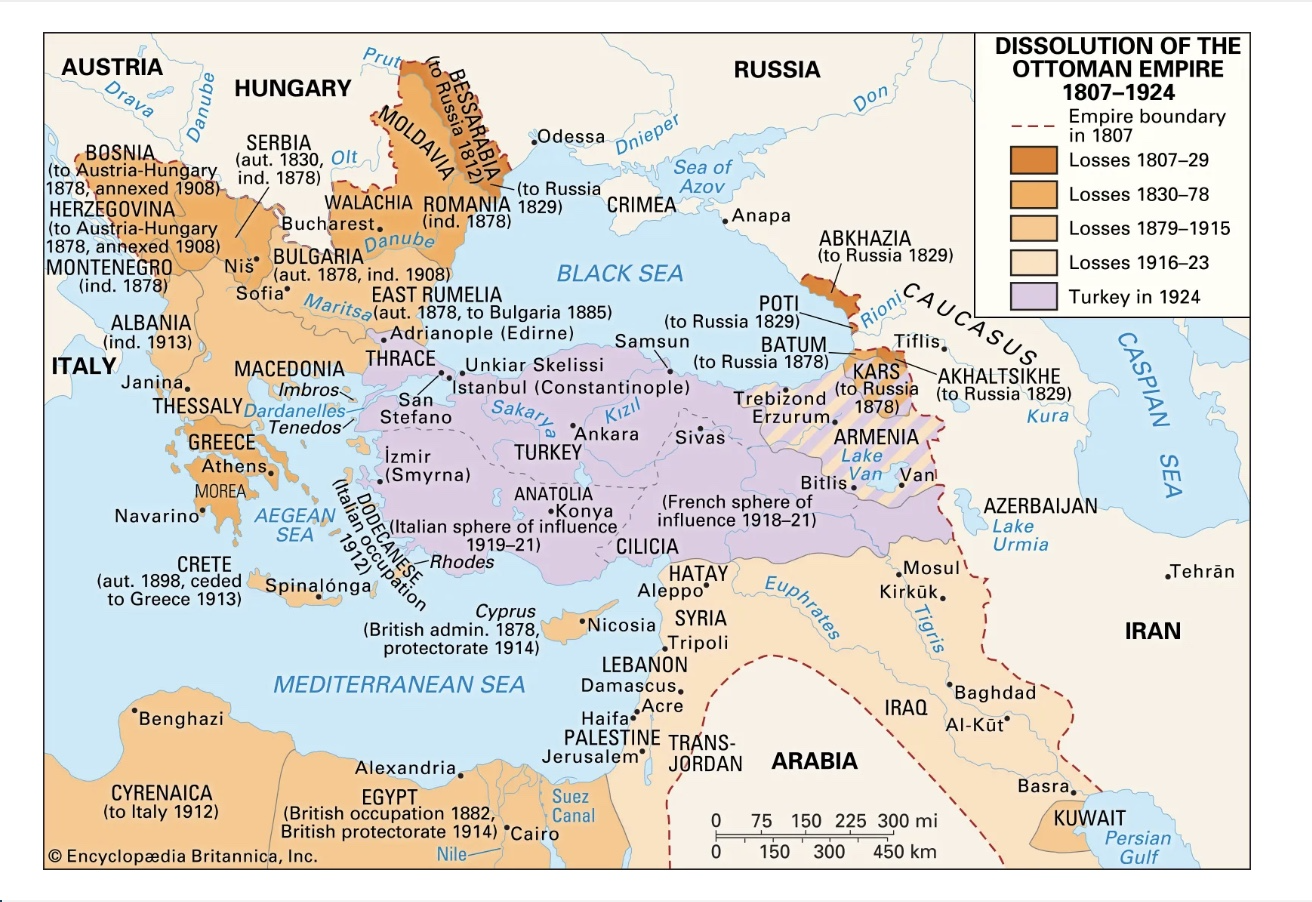
I like this map because it shows us the dissolution of the Ottomans through the 1800s. As the empire dissolved, lands that had been ruled by the Ottomans for centuries were claimed, divided, held, bartered and sold to the victors of various wars. Confusion and strife accompanied the changes. The peoples in those lands, say Greece, had no say, no democratic vote as per who or what would rules their lives after the Ottomans.
I use Greece because I have some knowledge here… My mother’s people are Greek. My maternal grandmother, Vera, came from Samos. Her people were refugees from the progroms against Greek speaking people in what is now Turkey. Their’s is a sad story of loss, death, survival. I am glad Vera did survive. I have named a granddaughter Vera.
My maternal Grandfather fought in the Greco-Turkish wars…
The Greco-Turkish War of 1919–1922 was fought between Greece and the Turkish National Movement during the partitioning of the Ottoman Empire in the aftermath of World War I, between 15 May 1919 and 11 October 1922.
Read about it here: https://en.wikipedia.org/wiki/Greco-Turkish_War_(1919–1922)
Here’s a blurb that I found interesting:
The Greek campaign was launched primarily because the western Allies, particularly British Prime Minister David Lloyd George, had promised Greece territorial gains at the expense of the Ottoman Empire, recently defeated in World War I. Greek claims stemmed from the fact that Anatolia had been part of Ancient Greece and the Byzantine Empire before the Turks conquered the area in the 12th-15th centuries. The armed conflict started when the Greek forces landed in Smyrna (now İzmir), on 15 May 1919. They advanced inland and took control of the western and northwestern part of Anatolia, including the cities of Manisa, Balıkesir, Aydın, Kütahya, Bursa, and Eskişehir. Their advance was checked by Turkish forces at the Battle of the Sakarya in 1921. The Greek front collapsed with the Turkish counter-attack in August 1922, and the war effectively ended with the recapture of Smyrna by Turkish forces and the great fire of Smyrna.
So, this tells me is that, after WW1, the Greeks were encouraged to wage war against the dead/ dying empire that had subjugate them for centuries. As were other peoples in other places. The Masters of War had unleashed hounds to ravage and harass what was left of the Ottomans.
Basically, the dead empire was being divided up by the victors. Often with force. Like hounds fighting over scraps the Masters of War did not want.
The “winners” of the war got first pick of the flesh still hanging off the bones of the Ottoman Empire. Some places are/ were more desirable than others.
The Suez Canal was/ is terribly important. It was claimed very early on in the proceedings as an asset belonging to the Masters… I note the subsequent fighting/ waring that has taken place in dispute of the Suez Canal.
I note that Iraq, Lebanon, Syria, Syria, and Palestine were big bones on the Ottoman carcass.
All but Palestine appear to be coveted, wanted, desired. Jerusalem was important but Palestine, rich in history, had few resources. No oil, no water, occupied by nomadic, Arabic speaking tribes. Much less coveted than, say Bagdad or Damascus.
The masters of war had made many promises to many people… keeping the promises proved impossible.
During World War I the great powers made a number of decisions concerning the future of Palestine without much regard to the wishes of the indigenous inhabitants. Palestinian Arabs, however, believed that Great Britain had promised them independence in the Ḥusayn-McMahon correspondence, an exchange of letters from July 1915 to March 1916 between Sir Henry McMahon, British high commissioner in Egypt, and Ḥusayn ibn ʿAlī, then emir of Mecca, in which the British made certain commitments to the Arabs in return for their support against the Ottomans during the war. Yet by May 1916 Great Britain, France, and Russia had reached an agreement (the Sykes-Picot Agreement) according to which, inter alia, the bulk of Palestine was to be internationalized. Further complicating the situation, in November 1917 Arthur Balfour, the British secretary of state for foreign affairs, addressed a letter to Lord Lionel Walter Rothschild (the Balfour Declaration) expressing sympathy for the establishment in Palestine of a national home for the Jewish people on the understanding that “nothing shall be done which may prejudice the civil and religious rights of existing non-Jewish communities in Palestine.” This declaration did not come about through an act of generosity or stirrings of conscience over the bitter fate of the Jewish people. It was meant, in part, to prompt American Jews to exercise their influence in moving the United States to support British postwar policies as well as to encourage Russian Jews to keep their nation fighting.
Read about it here: https://www.britannica.com/place/Palestine/World-War-I-and-after
2023, over 100 years since the Balfour Declaration. Where are we?
Hard to say, I am pondering what to write here… where are we? Where d’fuk are we?
On fire is the answer.
Paying the price for past colonial and imperialist schemes and dreams?
As Zion burns
more later
 The Native Iowan
[…] 2023 v10.Ancient History […]
By: 2025 v6. Sublime Sunday Coming Down | The Native Iowan on June 22, 2025
at 1:50 am