I remember vividly moving from rural Iowa, heading off to the new world of being a Peace Corps Volunteer. Moving from the solid, flat old-country to the steamy, rugged and dark islands of Melanesia.
I think I learned a lot about islands very quickly. Quickly for a flat-lander, that is. I learned that some beaches are golden sugary-fine coral sand, while others are black coarse volcanic sand. Some islands have surface water (rivers, stream, lakes), while other have no visible water sources.
I remembered Gilligan’s Island was a “desert-island”, so some of the stuff I learned made sense and some did not.
It took me a long time to figure out that wells in coastal areas would have “sweet-water” in the top layer of the well, and brackish or “sour-water” in the lower levels. The deeper you went the more brackish or sour the water became.
Now I am no scientist but I am an engineer. And a farmer! I think of myself as a quite astute “problem-solver”.
I remember the communal well at Siota PSS, on the Island of Small Nggela…
The school is still there: 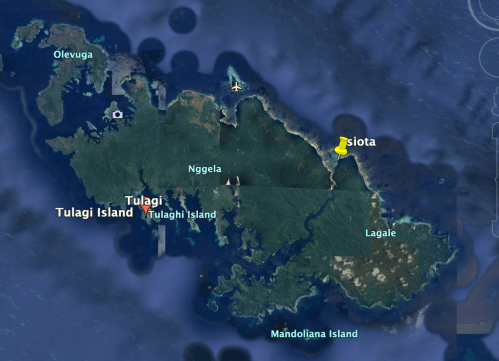

Now, in the major scheme of things Small Nggela is a small island. But it is a “big” island when it comes to islands and it has a lot of surface water. Big rivers, small streams, plenty of water.
But the school is in a weather shadow. The eastern side of the island got the weather, was the “weather-coast” of this island. Siota, though wet by many standards, did not have running water in close proximity.
One very important lesson I learned at Siota was how to manage freshwater resources.
The school satisfied its freshwater needs through a combination of water catchment and wells. When it rained it rained! Tanks would overflow, everyone had water when the rains came. The “kink” here was that the area went through frequent dry spells. A dry spell could be anything from a few days to weeks.
The facts about water catchment are simple: 1mm of rain on a square meter of roof space equals 1 litre of water. A 10mx10m square roof thus produces 100 litres for every 1mm of rainfall. Even though it rains a lot, your storage is what counts. You need to store the water and storage capacity is limited to the size of the tank(s) you have. The more you can store the longer the dry spell you can endure.
It’s easy for a person to need/ use 100litres of water a day for cooking, cleaning, personal use. Siota had about 300 students and staff living on site. That puts Siota’s daily water needs were around the 30,000 litre per.
Siota had nowhere near 30k litres of water storage capacity.
Once the rain ceased people had to stop using their rain tanks gratuitously. Water caught and stored in the tanks was reserved for cooking/ drinking. The wells were used for bathing and laundry.
The well I used, the men’s well, was by the HeadMaster’s house at the east side of the school. It was over 100meters from the sea-side. Of simple construction, three, 2meter, concrete culverts had been dug into the ground. The bottom was open, sandy. A nice concrete apron had been laid around the well. We used a plastic bucket with a bit of rope to draw water. You’d toss the bucket in the well, shake n pull the rope until the bucket started filling, then haul out your bath or laundry water. I learned quickly that the deeper you let your bucket sink the more brackish the water. It was a trick to be able to get a full bucket of fresh water.
I found that in times when the well was “high” there was a nice thick layer of freshwater. You did not have to worry about the bucket sinking too deep and filling up with sourwater.
I found that as the water level in the well dropped the freshwater levels decreased, but the sourwater levels remained fairly constant.
This puzzled me. I slowly worked it out…
Different from what I thought first-off, seawater and underground water aren’t isolated systems. The well isn’t filled up by rain water, like a rain gauge. The freshwater in the well is part of the freshwater aquifer. Below the freshwater aquifer was the seawater. The seawater and the freshwater are actually in the same well at the same time. The freshwater floated on top the saltwater.
Rocks, soil, sand, “the ground” is more or less porous. Water can move through (albeit slowly) so the rains supply the overall aquifer. Freshwater, being lighter than saltwater, floats on top of the saltwater. When the freshwater aquifer or “lens” is well supplied, the wells were fuller and the freshwater layer in the well was thicker. As the dry spells lasted the freshwater lens for the entire island shrunk as was evidenced in the well.
I moved from Siota to Taro Island in Choiseul Bay. Taro is a much, much smaller island. Its wells were shallower and more prone to brackishness. We relied on our water tanks heavily and were in strict control of how much freshwater was used.
Much later in life I spent time bouncing around the Vona Vona lagoon. One island I canoed past regularly, on my way to Zipolo Habu, had quite a big population, numerous houses, possibly upwards to a couple hundred people, men women and kids.
It was a “small” island, maybe 300meters long and 50 meters wide. It had large trees and one could see gardens as you canoed past.
Then one trip I saw that everyone had moved away. I didn’t travel that area often so I don’t think this all happened quickly, within 12 months or so the island went from being pretty well populated to being depopulated. I noticed the greenery on the island was gone. Except for the magroves…

While there are a number of trees that tolerate some soil salinity and salt over-spray, there is just one species, the mangrove, that actually grows submerged in salt water. The mangrove is specifically adapted not only to survive the dehydrating effects of salt, but to thrive and spread.
So, as we canoed past what was now a ghost-village, I asked my buddy, Patu… “Why did the people move?” His simple answer was classic SI pijin… “Water hem finis”. (The water is finished)
As the years went by and I canoed through the glorious Vona Vona lagoon, I paid special attention to this island that had been “murdered”.
As the vegetation died and rotted the seas encroached more and more. The big trees fell down. The magroves (the pict above not from this island) spread their influence. The little jetty got washed away, the houses all rotted to mulch. It’s probably been over 15 years since the folks left this island. The last time I checked it out it was a magove-swamp-type-sand-spit.
So what makes me think of dying islands?
I while back I was invovled in an eclectic and friendly, intelligent conversation about this news item…https://www.9news.com.au/world/60-minutes-solomon-islands-climate-change-global-warming-rising-sea-environment/3712f288-6c55-4b5e-aeb6-96adefb1e2bc?fbclid=IwAR2f0-NdrhaSc-Os_Ye8NeVqvMfe6zg32KlB1pOC-3qa-5d7fk-jomVsktc
Now as I see it, the “global warming” band wagon is much like any other extremist ideal. Their horizon is limited. They are almost incapable of open discussion.
I agree there are way too many facts to consider without research. And tho I do not completely agree with the info the referenced programme purveyed, I understand its view point.
And I consider the “reporting” in this 60 minutes segment as sensationalistic. They stretch the facts to suit their narrative.
When it was posted in a group I belong to, I asked the person who posted it if he had watched the programme. He had not, but the theme and the spiel advertising the programme suited his agenda. He posted it with the title “sobering”. I challenged this and was called names and insulted. I ddi not argue that teh programme was anything but sensationalistic. I didn’t say it was bullshit, false or wrong.
I tried to find out what, about the programme he found sobering, but of course such could not be answered because he had not watched the programme. All he could do was reference other matters in an attempt to distract the discussion.
When challenged the discussion became childish. I was called a “crack-pot” and was told how sad I was for holding such foolish ideas.
My view points don’t count when I disagree with truths he has adopted. He rejects out of hand my views with insults.
But to reject other view points is not very intelligent. Extreme views tend to grab an ideal and hold it as fact and irrefutable and uncontroversial. And to attempt to refute becomes blasphemy.
Not very intelligent to NOT listen to other facets of the whole story, me thinks.
Everything I read tells me that there is sea level rise and that sea level rise and sea level fall, overall, is not uncommon. During the various ice ages we have experienced, ice caps have grown and sea levels have dropped. Then reversed.
I understand that Sea level reportedly continues to rise at a rate of about one-eighth of an inch per year… The two major causes of global sea level rise are thermal expansion caused by warming of the ocean (since water expands as it warms) and increased melting of land-based ice, such as glaciers and ice sheets.
Interesting enough sea level rise is not global. I site Tuvalu as an example, where landmass there is actually increasing… https://www.maritime-executive.com/article/land-area-of-low-lying-tuvalu-has-increased
The above referenced programme stated that water in the Solomons had risen 15cm/ 6inches over the past 20 years. The info I ref above gives us an1/8th inch rise annually compared to the reported 6inches divided by 20years for is 1/3rd of an inch… compared to 1/8th of n inch… or 8.45mm compared to 3.175mm. A variance by a factor of almost three.
I still claim the referenced programme is sensationalism in the guise of newz.
Big smiles and More Later…
 The Native Iowan
Leave a comment